Singapore's education system puts critical thinking at the heart of what students need to succeed. The Ministry of Education's 21st Century Core Competencies framework makes this clear: students must learn to analyse, evaluate, and create, not simply memorise and reproduce.
This is where Math Olympiad programmes prove their value. Yes, they prepare students for competitions. But the real benefit runs deeper. Students who go through rigorous Math Olympiad training consistently perform better in school examinations, show stronger readiness for high-ability assessment, and handle secondary school mathematics with greater confidence.
So what exactly do Math Olympiad programmes develop, and why should parents consider them even if their child has no interest in winning medals?
Critical Thinking Skills Developed Through Math Olympiad
Math Olympiad training pushes students beyond standard textbook problems. It challenges them with non-routine questions that require creative and analytical thinking.
Logical Reasoning and Analytical Thinking
Logical reasoning sits at the core of Math Olympiad training. Students learn to:
- Break down complex problems into smaller, manageable parts
- Spot patterns and relationships within mathematical scenarios
- Apply systematic approaches to reach solutions
- Check whether their reasoning holds up
These analytical skills transfer well beyond mathematics. They help with science, language comprehension, and everyday problem-solving.
Problem-Solving with Speed and Accuracy
Math Olympiad competitions give students a limited time to solve challenging problems. This pressure builds two essential capabilities.
Speed comes from learning to recognise problem types quickly and select the right approach. At Terry Chew Academy, students learn 28 essential problem-solving strategies that help them tackle unfamiliar questions efficiently.
Accuracy comes from understanding concepts deeply and applying the correct steps consistently. When students know why they are doing each step, correct answers follow naturally. Careful checking under time pressure then ensures unnecessary marks are not lost.
Making Connections Across Topics
Math Olympiad problems often require students to combine concepts from different areas. A single question might blend geometry, number patterns, and logical reasoning all at once.
This cross-topic thinking develops the ability to think outside the box, a key component of the MOE's 21st Century competencies. Students begin to see mathematics not as a collection of separate chapters but as an interconnected body of knowledge where insights from one area can solve problems in another.
Resilience and Confidence Building
Math Olympiad training exposes students to problems that do not yield easily. Through guided practice, they develop:
- Mental stamina to persist with difficult questions
- Resilience to learn from mistakes instead of feeling defeated
- Confidence in their ability to tackle unfamiliar challenges
- A growth mindset that sees difficulties as learning opportunities
These psychological benefits may prove as valuable as the mathematical skills themselves. They prepare students for challenges throughout their academic journey.
How Math Enrichment Helps Students Stay Ahead of the MOE Syllabus
Some parents wonder whether Math Olympiad training helps with school performance or only matters for competitions. The evidence points strongly toward benefits in both areas.
Olympiad Skills That Apply to PSLE
The problem-solving techniques taught in Math Olympiad training work directly on challenging PSLE problem sums. Techniques such as:
- Excess & Shortage for systematic comparison and difference analysis
- Method of Assumption for strategic approaches to guess-and-check problems
- Working Backwards for reverse-engineering from answer to question
These strategies give students powerful tools for tackling the most difficult examination questions, the ones that separate AL1 students from everyone else.
Deeper Conceptual Understanding
Traditional mathematics instruction often focuses on the "how" of solving problems, the procedures for specific question types. Math Olympiad training emphasises the "why", the underlying concepts and principles that make those procedures work.
This deeper understanding means that when students face unfamiliar question formats or tricky variations, they can reason their way to solutions. They are not stuck simply because they have not seen that exact problem type before.
As PSLE questions grow more complex and less straightforward, this conceptual flexibility becomes increasingly important.
Achieving A*/AL1 Results
Results speak clearly. At Terry Chew Academy, 95% of students achieve a minimum 2-grade improvement within 6 months. This happens not through excessive drilling but through developing genuine mathematical competence.
Students trained in Math Olympiad methodology excel in school examinations because they possess the thinking skills that challenging questions are designed to test.
GEP/High-Ability Assessment and Math Olympiad: The Connection
Many parents exploring Math Olympiad training also have GEP/High-Ability Assessment (Gifted Education Programme) preparation in mind. The good news is that these two goals support each other well.
Skills That Overlap Between GEP/High-Ability Assessment and Math Olympiad
According to Terry Chew Academy's curriculum specialists, the GEP/High-Ability Assessment Screening test assesses three key abilities:
- Visualisation involving spatial reasoning and mental manipulation of shapes
- Logical reasoning requiring systematic thinking and deduction
- Pattern spotting for identifying relationships and sequences
These are precisely the skills that Math Olympiad training develops. In fact, Math Olympiad preparation is more comprehensive than GEP/High-Ability Assessment preparation alone because it also requires students to master specific mathematical concepts and competition strategies.
The practical implication: Students trained in Math Olympiad already possess the skills required for High-Ability Assessment and tend to excel in the General Ability component of GEP.
Speed and Accuracy for GEP/High-Ability Assessment
The GEP/High-Ability Assessment test runs under strict time constraints. Students must work quickly and accurately. Math Olympiad training develops exactly this capability through:
- Regular timed practice sessions
- Strategies for quickly identifying solution approaches
- Techniques for checking answers efficiently
Students familiar with competition pressure find the GEP/High-Ability Assessment environment less stressful and more manageable.
DSA (Direct School Admission) Opportunities
Beyond High-Ability Assessments, Math Olympiad achievements significantly strengthen Direct School Admission applications for top secondary schools. Schools like Raffles Institution, Hwa Chong Institution, and NUS High School of Math and Science actively seek students with demonstrated mathematical talent.
A solid record of Math Olympiad medals provides concrete evidence of exceptional mathematical ability, capacity for rigorous academic work, and willingness to pursue excellence beyond minimum requirements.
For parents considering elite secondary school pathways, Math Olympiad training represents a strategic investment in their child's future opportunities.
Programmes That Bridge School and Competition Maths
Effective Math Olympiad training should complement school mathematics, not compete with it. The best programmes enhance both competitive and academic performance.
Primary Maths Programme (P4-P6)
For students in Primary 4 to Primary 6, programmes that build strong conceptual foundations for PSLE while incorporating Olympiad thinking skills offer the best combination. The target: achieving AL1 within 6 months or less through:
- Systematic concept building
- Problem-solving strategy training
- Regular assessment and feedback
- Exam preparation and practice
GEP/High-Ability Assessment & Junior Olympiad Programme (K2-P6)
For younger students from Kindergarten 2 through Primary 6, specialised programmes prepare them for both GEP/High-Ability Assessment and junior-level competitions, including:
- SMKC (Singapore Math Kangaroo Contest)
- SASMO (Singapore and Asian Schools Math Olympiad)
- SEAMO (Southeast Asian Mathematical Olympiad)
- RMO (Raffles Mathematical Olympiad)
- NMOS (National Mathematical Olympiad of Singapore)
- SMOPS (Singapore Mathematical Olympiad for Primary Schools)
- APMOPS (Asia Pacific Mathematical Olympiad for Primary Schools)
These programmes build foundational thinking skills while preparing students for specific competition formats. For detailed information on competitions and timing, see our Math Olympiad competition calendar.
Online Options for Flexibility
Recognising that families have different scheduling needs, quality Math Olympiad programmes are also available online:
- LIVE video interaction (not pre-recorded content)
- Same curriculum and framework as in-person classes
- Available for students from P1 to S4
- Flexibility for families with location or scheduling constraints
Online options make quality Math Olympiad training accessible regardless of location within Singapore.
Long-Term Benefits Beyond Primary School
The skills developed through Math Olympiad training continue to provide advantages well into secondary school and beyond.
Foundation for Secondary Math Olympiad
Students who begin Math Olympiad training in primary school are well-positioned to continue into secondary competitions:
- SMO Junior and Senior on the Singapore Mathematical Olympiad pathway
- AMC8 and AMC10 from the American Mathematics Competition
- SEAMO, SEAMO X, and SX on the Southeast Asian Mathematical Olympiad pathway (SEAMO runs from Kindergarten to Pre-University, with SEAMO X as the invited round for top performers, and SX as the champion round)
The thinking skills and mathematical maturity developed in primary school provide a strong foundation for these more challenging competitions.
Academic and Career Advantages
Beyond competitions, Math Olympiad skills support:
- Top school admissions through both DSA and regular pathways
- STEM career foundations since critical thinking and problem-solving are essential for science, technology, engineering, and mathematics careers
- General academic success as analytical skills transfer to all subjects requiring logical thinking
The investment in Math Olympiad training pays dividends throughout a student's academic journey and into their professional life.
Is Math Olympiad Right for Your Child?
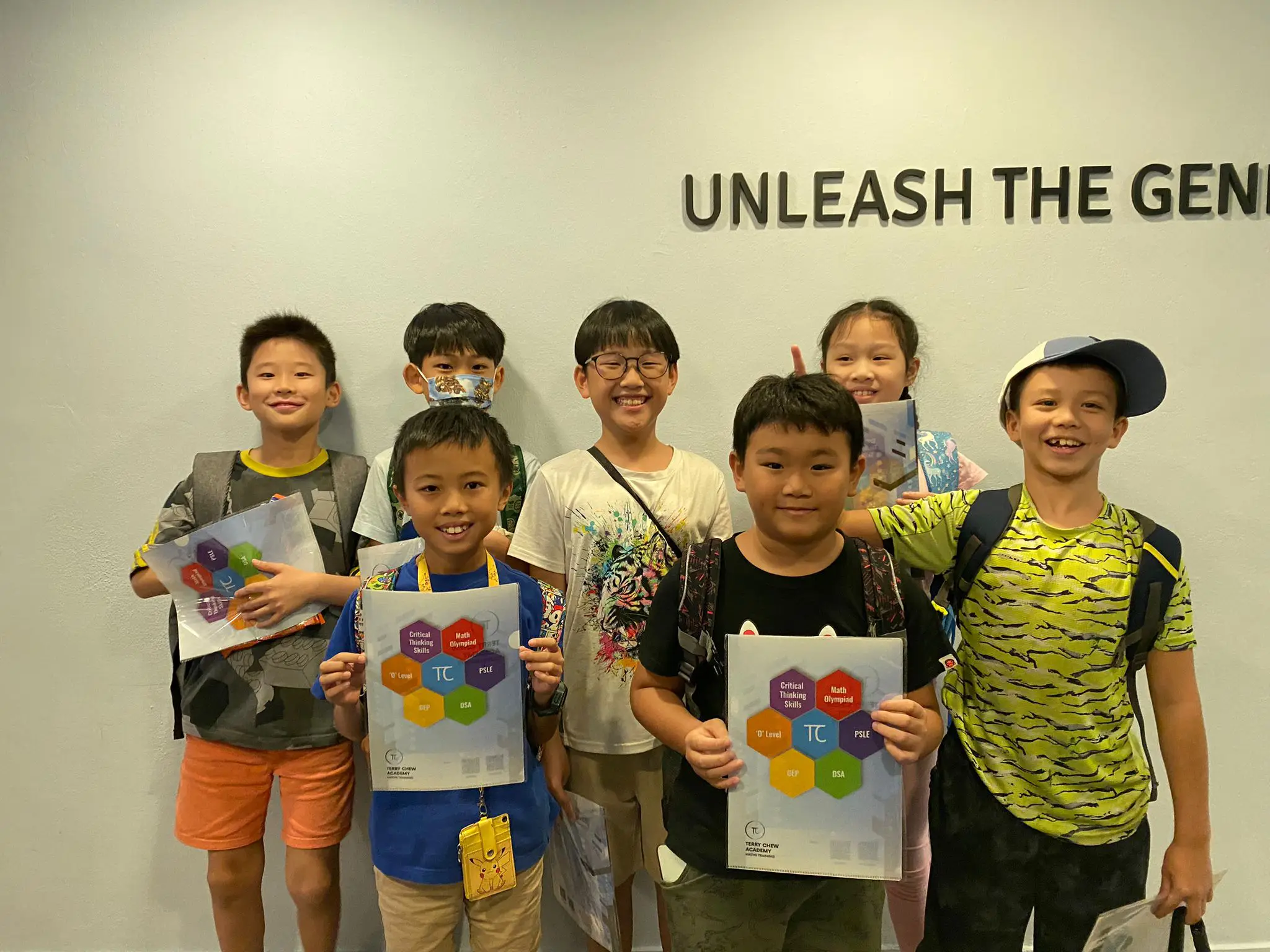
Not every child needs to become a competition champion. But nearly every child can benefit from the thinking skills that Math Olympiad training develops.
Signs Your Child May Benefit
Consider Math Olympiad training if your child:
- Enjoys puzzles and mathematical challenges showing natural curiosity about numbers and patterns
- Asks "why" questions wanting to understand how things work, not just follow procedures
- Finds school maths too easy and needs more challenging material to stay engaged
- Struggles with problem sums and could benefit from systematic problem-solving strategies
- Is preparing for GEP/High-Ability Assessment Screening and needs to develop the tested cognitive skills
- Aims for top secondary schools and wants to build a competitive DSA portfolio
Starting at the Right Level
The key to successful Math Olympiad training is beginning at the appropriate level for your child's current abilities. Programmes that are too advanced cause frustration and discouragement. Programmes that are too basic fail to challenge.
Quality centres like Terry Chew Academy offer programmes starting from K2 onwards, with proper diagnostic assessment to ensure each student is placed appropriately.
For guidance on the ideal age to begin training, see our detailed guide on when to start Math Olympiad.
Unlock Your Child's Mathematical Potential
Math Olympiad training develops critical thinking skills that benefit students in competitions, school examinations, GEP/High-Ability Assessment Screening, and beyond. The analytical abilities, problem-solving strategies, and mental resilience built through rigorous mathematical training provide advantages that last throughout academic life and into future careers.
Key benefits of Math Olympiad programmes:
- Development of critical thinking and logical reasoning skills
- 28 essential problem-solving strategies applicable to PSLE
- Preparation for GEP/High-Ability Assessment Screening and DSA applications
- Foundation for secondary school mathematical excellence
- Confidence and resilience when facing challenging problems
Whether your child aims to win competition medals, achieve AL1 in PSLE, or simply develop stronger mathematical thinking, Math Olympiad training offers a proven pathway to success.
Explore the programmes available at Terry Chew Academy to find the right fit for your child's level and goals.
For help selecting the best programme, read our comprehensive guide on how to choose a Math Olympiad tuition centre.

 Like us