
Standard school revision often focuses on repeating the same steps until a child can do them without thinking. While this helps with school exams, it does not prepare them for the challenges found in mathematics competitions.
We see this often: students who ace school tests can stumble when faced with their first competition paper. This happens because these events require a different way of thinking from the standard education curriculum.
At Terry Chew Academy, we focus on helping your child handle these non-routine challenges.
Key Takeaways
- Mathematics competitions require logical intuition and non-routine problem-solving skills that go beyond the standard school curriculum.
- Mastering question types, such as Combinatorics and Geometric Intuition, helps students navigate complex puzzles without relying on rote memorisation.
- Developing a strong grasp of number properties through Diophantine Equations and Modular Arithmetic simplifies large-scale mathematical challenges.
- Competitive maths formats, ranging from proof-based questions to team relays, build essential skills in accuracy, communication, and mental agility.
- Specialised training through frameworks such as RA*CE can significantly improve both school grades and medal prospects at prestigious Olympiads.
How are Mathematics Competitions and School Revision Different?
School revision is mostly about following a set of instructions. Your child learns a formula, sees an example, and then completes twenty similar questions. This method ensures they remember the steps for their exams. However, it does not always teach them how to handle a problem they have never seen before.
Mathematics competitions are different. They do not prompt your child on which formula to use.
Instead, they provide a puzzle that requires logical reasoning. Your child must look at the information and decide on a strategy from scratch.
School revision is like following a map, while competition maths is like navigating a forest with only a compass. One relies on memory while the other relies on logic.
Popular Mathematics Competitions in Singapore
.webp)
Singapore is home to several prestigious events. These competitions test a range of skills and logic. We recommend that your child participate in these to build confidence and enjoy a more engaging learning journey.
- SMKC (Singapore Maths Kangaroo Contest): Held in April, this competition focuses on logical puzzles rather than just difficult sums.
- SEAMO (Southeast Asian Mathematical Olympiad): Round 1 typically begins in August, with Round 2 (the invitational round) held in January each year. The exact date varies across countries and regions. This competition emphasises mathematical intuition and the ability to apply logic to unfamiliar scenarios.
- SASMO (Singapore & Asian Schools Maths Olympiad): This is one of the largest competitions in Asia. It is held in April and serves as a great starting point for primary and secondary students.
- RMO (Raffles Mathematical Olympiad), previously known as RIPMWC: This event takes place in April (Round 1) and May (Round 2), for Primary 4 to Primary 6 students across Junior and Open Categories.
- SMO (Singapore Mathematical Olympiad): The biggest competition for secondary school students. It has categories such as Junior, Senior, and Open. Round 1 is typically held in late May or early June, with Round 2 in late June.
7 Question Types Students Will See in Mathematics Competitions
When entering maths competitions, your child will encounter a different question style than what they see in class.
These question types are rarely found in standard textbooks. Specialist Maths Olympiad programmes train students to recognise these question types and develop reliable solving strategies.
Combinatorics
Combinatorics is the branch of mathematics focused on counting. Problems involve counting vast numbers of possibilities without actually listing them out.
Take, for example, how many different ways can you arrange the letters in the word "BANANA"?
Combinatorics deals with solving this without listing every arrangement by hand. Here’s how you can do it.
- First, count the total number of letters. There are 6 letters.
- If all letters were different, there would be 6x5x4x3x2x1 = 720 ways. The formula is this way because when you go to fill the first position, you have 6 different letters to choose from. You pick one and place it down. Now, you move to the second position. Since you have already used one letter, you have only 5 left in your hand. And so on.
- However, some letters repeat. There are three 'A's and two 'N's. When letters repeat, swapping two identical letters (like one 'A' with another 'A') does not create a new, distinct arrangement. To fix the over-counting from Step 1, we must divide the total by the number of ways those repeating letters can be shuffled amongst themselves.
- Divide 720 by the arrangements of 'A's (3! = 6) and 'N's (2! = 2).
- The calculation is 720 / (6 x 2) = 60.
- There are 60 ways.
Through combinatorics, your child develops systematic thinking. They learn to break down large, messy groups into organised parts.
Geometric Intuition
School geometry is often about using a protractor or applying a formula. Your child knows that to find the area of a rectangle, you multiply length by width, and to find the perimeter, you add the lengths of all the sides.
Competition geometry asks for something more. Your child has to see shapes within shapes, and often draw auxiliary lines to make a problem solvable. It is about spatial awareness and visual logic.
.webp)
For example, inside a square with a side length of 10 cm, four semicircles are drawn, each using one side of the square as its diameter. Find the total area inside the square that is covered by more than one semicircle (the four "petal" regions where the semicircles overlap).
- First, we note the key dimensions given in the problem
- Side of the square (s): 10cm
- Radius of each semi-circle (r): Since the diameter is the side of the square, r = 10/2 = 5.
- Think about double-counting. If you shade all four semicircles inside the square, some parts of the square get shaded once and some get shaded twice. The parts shaded twice are exactly the overlap regions we want to find.
Here is the clever bit. In this configuration, every overlap region is covered by exactly two semicircles. So when you add up the areas of all four semicircles, you are counting the square once and counting the overlap regions twice.
This gives us a neat relationship:
Total area of the four semicircles = Area of the square plus Area of the overlap regions
- Rearrange to find the overlap
- Area of overlap = Total area of four semicircles - Area of square
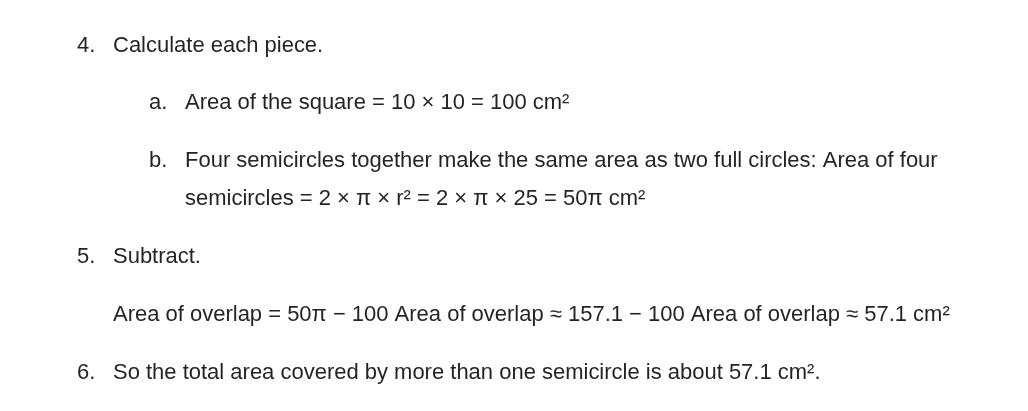
A quick word of caution. In competition maths, wording matters. If a question asks for the area where all four semicircles meet at the same time, the honest answer is 0, because the four semicircles only meet at a single point in the centre of the square. The question we solved above asks for the area covered by two or more semicircles, which is a very different region. Training your child to spot this difference is one of the most valuable habits competition maths builds.
This kind of problem sharpens visual-spatial reasoning. It pushes students to combine different pieces of geometric knowledge to work out shaded regions, and it teaches them to read each diagram carefully before reaching for a formula.
Diophantine Equations
These are algebraic equations where we only care about integer solutions. In school, x can be any number like 2.5 or 3.14.
In competitions, your child might be told that x and y must be whole numbers. This limitation makes the problem a puzzle of factors and multiples.
For example, find all pairs of positive integers (x, y) that satisfy the equation xy + 2x + y = 10.
To solve this, we use a technique called Simon’s Favourite Factoring Trick. We want to force the left side of the equation into a factorable form.
- Start with xy + 2x + y = 10.
- Factor x out of the first two terms: x(y + 2) + y = 10.
- To complete the factoring, we need the y-term to match the first term (y + 2). We do this by adding 2 to both sides of the equation: x(y + 2) + (y + 2) = 10 + 2
- Now, factor out (y + 2). This would be: (x + 1)(y + 2) = 12
- Since x and y are positive integers (x, y >= 1), then x + 1 2 and y + 2 >= 3. We look for factor pairs of 12 that satisfy these conditions:
- 2 x 6 = 12 -> x+1=2, y+2=6 -> (1, 4)
- 3 x 4 = 12 -> x+1=3, y+2=4 ->(2, 2)
- 4 x 3 = 12 -> x+1=4, y+2=3 ->(3, 1)
The pairs are (1, 4), (2, 2), and (3, 1).
This builds a thorough understanding of number properties. Your child learns to use constraints to narrow down possibilities. It teaches them that maths is not just about calculating, but about identifying patterns and limitations.
Pigeonhole Principle
This is a fundamental idea in mathematics competitions: if you have more pigeons than pigeonholes, at least one hole must contain more than one pigeon. It sounds obvious, yet it powers some of the most elegant proofs in Olympiad maths.
For example, in a group of 10 people, each person has between 2 and 18 friends, and every friend count is an even number. Prove that at least two people in the group must have the same number of friends.
- Identify the ‘holes.’ The possible even friend counts are 2, 4, 6, 8, 10, 12, 14, 16, and 18.
- Count the holes. There are 9 possible even friend counts in total.
- Identify the "pigeons". The 10 people in the group are the pigeons. Each one has to land in one of the 9 possible friend counts.
- Apply the principle. With 10 pigeons and only 9 holes, at least one hole must contain two or more pigeons. In other words, at least two people must share the same friend count.
- This proves the statement.
The Pigeonhole Principle develops logical proof skills. Your child learns to argue a point with mathematical certainty, using the structure of the problem rather than trial and error. It also trains them to spot when a problem is really a counting question in disguise.
Modular Arithmetic
Often called "clock arithmetic," this focuses on remainders. School maths focuses on the quotient (how many times one number fits into another).
Competition maths focuses on what is left over. This is incredibly useful for solving problems involving cycles, such as days of the week or last digits of huge numbers.
For example, what is the last digit of 3^24601?
- Look for a pattern in the powers of 3
- 3^1 = 3 (last digit 3)
- 3^2 = 9 (last digit 9)
- 3^3 = 27 (last digit 7)
- 3^4 = 81 (last digit 1)
- 3^5 = 243 (last digit 3)
- The pattern 3, 9, 7, 1 repeats every 4 powers.
- Divide the exponent 24601 by the cycle length 4.
- 24601 / 4 gives a remainder of 1.
- The first number in the cycle is 3.
- The last digit is 3.
If there had been no remainder, the last digit would have been ‘1’, the last digit of the cycle count. Your child gains a strong sense of number cycles and patterns. They learn to handle very large numbers by simplifying them into smaller, manageable parts.
Invariance and Parity
Invariance is the study of what stays the same, even after you perform operations on a system. Parity refers to whether a number is odd or even.
Mathematics competitions use these ideas to prove that certain tasks are impossible, no matter how clever your strategy.
For example, you have 20 magnets arranged in a row. Some show their plus-pole, and some show their minus-pole. The starting position has exactly 7 plus-poles facing up. You are allowed only one move: flip any two magnets at the same time. Can you ever reach a state where all 20 magnets show the same pole?
- Track what changes when you flip two magnets. Let P be the number of plus-poles facing up. Each move does one of three things:
- Flip two minus-poles to plus-poles: P increases by 2.
- Flip two plus-poles to minus-poles: P decreases by 2.
- Flip one of each: P stays the same.
- Spot the invariant. In every move, P either stays the same or changes by 2. This means the parity of P (whether P is odd or even) never changes.
- Apply the invariant to the goal. You start with P = 7, which is odd. So at every point during the game, P will remain odd.
For all 20 magnets to show the same pole, you would need either:
- P = 0 (all minus-poles), which is even, or
- P = 20 (all plus-poles), which is even.
Both goal states have the same P value. But P is locked into being odd for the entire game. So neither state can ever be reached.
The answer is No. It is impossible to make all the magnets show the same pole, no matter how many moves you make.
Notice how this argument never tries to find the right sequence of moves. It proves the task is impossible by spotting one quiet feature, the parity of P, that the rules can never change. That is the heart of invariance.
This kind of thinking teaches your child to look beyond calculations. They learn that some problems are about understanding the state of a system, and that finding the right invariant can settle a question in a few short lines. It builds high-level analytical skills that pay off well beyond the competition room.
Logic and Cryptarithms
Cryptarithms are mathematical puzzles where each letter represents a distinct digit. To solve them, your child must use logical deduction rather than trial and error. They have to understand how addition and carrying work at a fundamental level.
For example, AB + BA = 121 (In most algebra problems, AB would mean A multiplied by B. In this particular puzzle, AB represents a two-digit number; no multiplication takes place between them)
What are the values of A and B?
- AB is 10A + B (Because A is in the tens place).
- BA is 10B + A (Because B is in the tens place).
- Now that you have the expanded forms, you can add them together as the original problem requires: (10A + B) + (10B + A) = 121
- You simply group the like terms together. You have 10A and A, which makes 11A. You also have B and 10B, for a total of 11B. So, 11A + 11B = 121
- You can see that 11 is a common multiplier for both A and B. By factoring it out, the equation looks like this: 11(A + B) = 121
- To find what A and B add up to, you divide both sides by 11. Since 121 / 11 = 11, you are left with: A + B = 11
- Any pair of digits that sums to 11 works, such as (A=2, B=9) or (A=5, B=6).
This enhances deductive reasoning. It bridges between basic arithmetic and algebra.
Question Formats that Students Will Encounter in Mathematics Competitions
Your child should be prepared for various ways these questions are presented. Mathematics competitions use a range of styles to keep students on their toes.
Proof-Based
In these questions, the final answer is less important than the explanation.
Your child must write a logical argument to prove why a statement is true. These are common in the later rounds of the SMO and in international Olympiads. It requires excellent communication from the participant.
Multiple Choice
Many competitions like SASMO use multiple-choice questions. However, these are not easy. There are often distractor answers that are common mistakes.
Some competitions even deduct marks for wrong answers, so students must learn when to guess and when to leave a blank.
Short Answer
These require a single number or a simple fraction. There is no partial credit for working.
This format tests your child's accuracy. A single calculation error can result in zero marks, even if the method was perfect.
Modelling
Modelling questions ask your child to apply maths to a real-world scenario. They might have to design a schedule or calculate the most efficient way to pack a box. These questions test how well they can turn a wordy, messy situation into a neat mathematical problem.
Team Relay
In a relay, students work in teams. The first student's answer is used by the second student to solve their problem. This adds a layer of pressure. Your child must be accurate not just for themselves, but for their teammates. It encourages cooperation and clear communication.
Rapid Fire
Some competitions have a countdown or buzzer round. Your child must solve problems in their head in seconds. This format tests mental agility and accuracy. It is often the most exciting part of a competition.
Prepare Your Child for Mathematics Competitions Today through Maths Tuition
We understand that you want the best for your child. Standard tuition helps maintain grades. To stretch your child to their full potential, you need specialist competition coaching.
At Terry Chew Academy, we specialise in helping students master non-routine problem solving, just as you’ve read in this guide, in order to prepare them for mathematics competitions.
Our primary strength lies in our RA*CE framework. This methodology was developed by our founder, Terry Chew, the author of the celebrated "Unleash The Maths Olympian in You!" series.
This framework helps your child recognise question patterns, analyse them, calculate with precision, and evaluate their results. We do not believe in rote learning. We focus on critical thinking.
Since 2014, 95% of our students have achieved a 2-grade improvement in their school maths within six months. More importantly, over 60% of our students go on to win medals in prestigious mathematics competitions. We offer small group classes, and 1-on-1 sessions are available on a limited and selective basis for advanced students, subject to availability.
Contact us at Terry Chew Academy today to find out how we can help your child succeed in their next competition.
Frequently Asked Questions
At what age should my child start preparing for mathematics competitions?
While students can begin at any time, we recommend starting as early as Primary 1 or 2 to build a strong foundation in logical thinking before the curriculum becomes more calculation-heavy.
Is maths olympiad training only for students who are already geniuses?
Not at all; while these problems are challenging, mathematical intuition is a skill that can be taught and developed through consistent exposure to non-routine heuristics.
How many hours a week should my child dedicate to competition prep?
It depends on your child's level and goals. For students starting out, about 1 to 2 hours of focused practice each week is a sensible baseline, often built around one structured lesson plus a short review at home. Students preparing for higher-stakes rounds, such as SMO or DSA portfolios, usually benefit from more dedicated practice in the months leading up to the competition. The key is consistency rather than long, infrequent sessions, which is how genuine problem-solving habits take root.
Do these competitions provide calculators, or must all problems be solved manually?
Primary-level competitions, RMO, and all SMO sections (Junior, Senior, Open) prohibit the use of calculators to test mental agility and number sense.
Can competition results be used for Direct School Admission (DSA) in Singapore?
Yes, strong results in NMOS, RMO (formerly RIPMWC), and APMOPS are highly regarded by top secondary schools during the DSA-Sec process. SMO results, in turn, support DSA-JC applications.

 Like us