
High-ability learners possess mental speed that outpaces that of their classmates—and, consequently, their classroom.
Regular tuition usually focuses on helping students gain confidence in their school exams. While this is helpful for the majority, highly able learners benefit from greater challenge and a more curated approach.
We have spent years at Terry Chew Academy working with such students, and we know their needs differ significantly from those of the average pupil. As such, we’ve written this guide detailing what these learners need from a tuition centre.
Key Takeaways
- High-ability learners require a specialised springboard curriculum that prioritises stimulation and complexity over the repetitive drill-and-practice found in standard tuition.
- Over-repetition can lead to disengagement, making a spiral learning approach essential for maintaining momentum and enthusiasm in gifted students.
- Mastering heuristics provides students with versatile problem-solving strategies that apply to unfamiliar, non-routine challenges.
- Advanced tuition centers offer a peer community of like-minded learners, fostering a competitive environment that encourages students to push their intellectual boundaries.
- Choosing the right center involves looking beyond vanity metrics to find experienced tutors who can facilitate cognitive growth and lifelong critical thinking skills.
What Sets High-Ability Learners Apart from Other Students
High-ability learners do not just do maths faster; they think about maths differently.
They often skip intermediate steps in their head because the logic is intuitive to them. This can sometimes lead to points being docked in school for "missing working." To a teacher, marker, or grader, these students’ papers might seem incomplete, when in fact, a lot of the intermediate work had already been done in their minds.
These learners crave complexity and can become disengaged from school when the classroom cannot keep pace. They have a high capacity for abstract thought and enjoy the challenge of a puzzle.
We find that these students often exhibit strong intellectual curiosity. A high-ability learner is often a self-starter who enjoys the thrill of solving. At our tuition centre, we see these learners keenly focused on non-routine problems—the type they don’t usually encounter in school.
What we observe in our classrooms is well-documented in the field of gifted education research. Educational psychologist Joseph Renzulli, founder of the National Research Centre on the Gifted and Talented, describes giftedness as the interaction of above-average ability, task commitment and creativity. His Schoolwide Enrichment Model, which informs gifted programmes worldwide, advocates curriculum compacting and enrichment over repetition for these students. Closer to home, Carol Ann Tomlinson's work on differentiated instruction reinforces the same principle: high-ability learners progress fastest when content, process and pace are tailored to readiness rather than averaged across a class.
What Makes For an Excellent Maths Tuition Centre in Singapore
An advanced maths tuition centre offers the following advantages over its regular counterparts:
- A curriculum that incorporates Mathematical Olympiad training.
- Materials that focus on non-routine and open-ended problems.
- Coaches who are trained in coaching, not just the material.
- Experienced tutors who have experience in teaching, publishing learning materials, and consulting for maths olympiads, competitions, and papers.
- A focus on acceleration that allows students to learn topics ahead of their school level.
- Opportunities to participate in international competitions like SASMO or the American Mathematics Competitions (AMC).
These additions make a tuition centre highly exceptional, allowing them to accommodate gifted students who often outpace their peers.
Why do High-Ability Learners Need More than Regular Tuition?
.jpg)
Standard tuition is a safety net. It is designed to catch students who are falling behind or to ensure a student stays on track with the school syllabus.
For a high-ability learner, instead of a safety net, they need a springboard. This helps them spread their wings and realise their potential.
The following are reasons why high-ability learners need more than standard tuition:
Better Mental Stimulation than Traditional Learning Formats
Standard learning formats are built on a linear progression. You learn Topic A, then Topic B, then Topic C.
For a gifted child, this pace is often boring and slow; since they might have the mental capability to assume the fundamentals of Topics B and C already, just from learning Topic A. We’ve encountered students who know how to “borrow from 0” during advanced subtraction, even before they were taught how to do it.
High-ability learners need mental stimulation that matches their processing speed. They thrive when they are presented with problems that require them to exercise different areas of maths simultaneously.
At Terry Chew Academy, we provide challenges that engage your child's brain in new ways. We focus on non-routine maths: the kind that keeps students excited and engaged. This keeps them stimulated and prevents boredom.
This need for richer stimulation is recognised at a national level too. Under the Ministry of Education's Gifted Education Branch, programmes such as Excellence 2000 (E2K) Mathematics and Mathematics Expert @ Work are designed specifically for High-Ability Learners in Primary 4 to 6. Both move away from drill-and-practice toward open-ended, inquiry-led tasks that build mathematical reasoning. The Primary Mathematics Project Competition, jointly run by the Gifted Education Branch and NUS High School of Mathematics and Science, is another example of the local ecosystem's shift toward creative, applied mathematics. A specialist maths centre should complement these school-based provisions, not duplicate them.
Over-Repetition Can Be Disengaging Rather Than Improving
In a typical tuition class, a student might do twenty versions of the same word problem to ensure they have mastered it. For your child, this becomes redundant. The work feels mundane rather than stimulating.
High-ability learners often master a concept after a few examples. Having them do twenty more does not improve their ability; it simply drains their enthusiasm.
They need a curriculum that moves on once mastery is achieved, though that pace may not suit every student. However, in a specialised tuition centre, coaches are trained to nudge students forward and keep them in step with the class.
Specialised tuition centres focus on spiral learning, where we revisit concepts through increasingly difficult applications of the same concept, rather than through simple repetition.
High-Ability Learners Need Heuristics
Standard tuition centers focus on problem-solving steps that are specific to a particular question type.
However, high-ability learners quickly outgrow these fixed templates. To truly excel and expand a gifted child’s critical thinking, they need Heuristics—versatile strategies that can be applied to any unfamiliar problem.
Heuristics allow a student to transform a complex problem into a decipherable one using techniques such as:
- Simplifying the Problem: Breaking a massive calculation into smaller, manageable patterns.
- Working Backwards: Starting from the end result to deduce the initial state.
- Drawing Diagrams/Models: Visualising abstract concepts to find relationships between numbers.
- Considering Extreme Cases: Testing the boundaries of a problem to identify its core constraints.
For a high-ability child, heuristics offer mental stimulation that they wouldn’t find in standard tuition centres or the classroom. It sets aside memorisation of solutions and develops the mental flexibility needed to tackle non-routine challenges.
The Need for Focused Tutors

In a regular tuition centre, the tutor often manages a wide range of student capabilities. They must often slow down for students who are struggling. This could mean that your child might not get the pace they need to thrive.
High-ability learners need tutors who can focus on their particular strengths and push them even further. They need someone who can spot inefficiencies and propose better solutions. As such, tutors shouldn’t just be masters of the concepts; they should also be exceptional coaches—clear communicators who can spot gifted students and give tailored attention.
They Need Experienced Tutors With a Mathematical Grasp Beyond the Textbook
Many tutors can teach from a textbook. However, very few can handle a high-ability learner who comes up with a solution outside of the textbook.
Gifted students may develop a curiosity beyond what the textbook covers. Whilst staying on track with the syllabus matters, tending to that curiosity in class matters just as much.
A tutor who’s only trained in the textbook might not be able to provide this stimulation. However, a tutor with an extensive mathematical background beyond that of the textbook would be able to keep learners engaged, interested, and asking questions.
A Learning Community Where They Can Spread Their Wings
In school or in a standard tuition centre, your child might feel the need to hide their ability to fit in with their peers. Or perhaps their environment doesn’t share their curiosity, so instead of their peers being a benchmark for them to do better, they sit back, convinced they’re already excellent.
In an advanced maths centre, high-ability learners are surrounded by other high-ability learners, with the same appetite for challenge and problem-solving. This creates a competitive community that thrives on challenge. They find peers who challenge them and who speak the same logical language. This social aspect is vital for their confidence.
A Centre That Strives for Lifelong Growth Rather Than Test-Taking Ability
Regular tuition is a sprint toward the next exam. Once the exam is over, the knowledge often disappears.
Maths is a language of logic that serves a person for their entire life. High-ability learners should be taught in ways that build their critical thinking skills.
We focus on the process of discovery. We want your child to learn how to learn. This mindset prepares them for success in university and in their future careers, regardless of the field they choose. Prioritising long-term cognitive development over short-term score-chasing is a more sustainable time investment, as this produces knowledge that doesn’t fade.
A Centre Focused on Real Results Rather Than Vanity Passing Rates
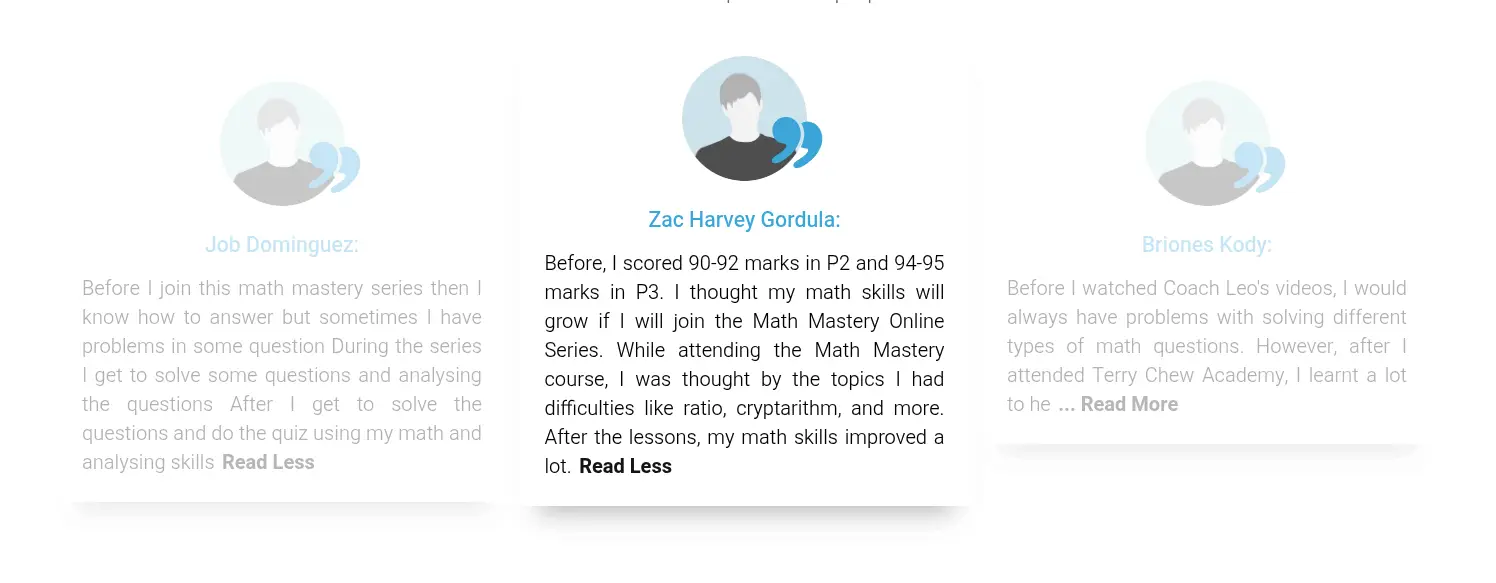
Tuition centres like to place their passing rates on their websites, which conveys the reliability of their method. This is an excellent indicator of success, but it’s worth noting the possibility of training students primarily using answer keys.
Real results, such as student stories and testimonials, hold more value. Regular tuition centres might lean on a test-focused approach to boost these vanity metrics. Advanced tuition centres, on the other hand, focus more on their students' academic performance and personal growth. They continuously refine their pedagogy and adopt new teaching methods to help students retain information better.
Test-taking and maths olympiad success should be secondary to real, cognitive growth. They should not be the main focus.
How to Assess a Maths Tuition Centre
The following are ways parents can assess the maths tuition centres they shortlist.
Through Their Website
A website is the digital billboard of maths tuition centres. Through the maths tuition centre’s website, parents can assess the tuition centre’s programs, their syllabus, their expertise, their approach and pedagogy, their publications, their tutors, the media that they’ve been covered and mentioned on, and pictures of their learning facilities.
Tuition centres’ websites will also include student testimonials, where parents can read students' success stories, as well as learning resources and blogs that reflect the centres’ commitment to education.
Make sure to thoroughly browse a tuition centre’s website, and not just their price.
In-Person
When you visit a centre, you experience the commute there, getting a better sense of whether it’s really “nearby”. You can also see their physical amenities. You can assess the quality of their classrooms, the cleanliness of the toilets, whether there are nearby outdoor distractions, and whether they have a pantry.
Visiting the centre also allows you to talk with the personnel there, so you can ask better questions and learn more about their methods. This in-person dynamic can retrieve better information for your judgment than back-and-forth emails.
Through a Trial Class
A trial class is the best way to see if the level of challenge is right. Observe your child after the lesson. Are they excited? A high-ability learner should leave a trial class mentally stimulated and engaged.
If they are bored, then the class is not the right place for them.
It’s advisable that you accompany your kids during the trial class, so you can also assess the teaching approach yourself.
Get in Touch with Terry Chew Academy Today
We have built Terry Chew Academy to be the premier destination for high-ability learners in Singapore. Our mission is to unleash the maths Olympian in every child. We do this through our RA*CE framework: Recall, Analysis, Calculation, and Evaluation. This system ensures that your child is not just getting the right answer, but is doing so through the most efficient and logical path possible.
We believe in building a strong foundation in logic that will serve your child for years to come, well beyond any single exam.
Our specialised programmes prepare students for the P3 GEP Screening (Stage 1) and the High-Ability Learners (HAL) pathway, in line with the Ministry of Education's refreshed approach to nurturing higher-ability learners from the 2024 Primary 1 cohort. We also coach students for major competitions, including NMOS, SMO, SASMO, and the AMC, and offer DSA coaching to help your child gain admission to their preferred secondary school.
We invite you to experience our approach firsthand. We offer a diagnostic assessment to identify your child's particular strengths and areas for growth. It gives us a clear picture of how your child thinks.
Contact us today to see how we can help your child reach their full potential and compete with confidence.
Frequently Asked Questions
Does your curriculum cover the standard school syllabus, or is it strictly for competitions?
Our curriculum is dual-track; we ensure students stay ahead of the school curriculum by having them master core topics early and also coach them on non-routine problems and heuristics that will be beneficial for competitions.
What is a diagnostic assessment, and how is it different from a school placement test?
Unlike school tests that measure what a child remembers during the test proper, our diagnostic assessment measures how a child thinks—specifically their ability to spot patterns and apply logic to non-routine problems.
Is it better for a gifted child to focus on one competition or join as many as possible?
We recommend focusing on one or two competitions per year to avoid burnout. This ensures they perform at their absolute peak in each event and maintain their school commitments.
Can advanced maths training help with Direct School Admission (DSA)?
Definitely; top-tier secondary schools in Singapore look for distinction as concrete evidence of a student's high mathematical potential.

 Like us