
A group of 10 people meet at a party. If every person shakes hands with every other person exactly once, how many handshakes are there in total?
Problems like these are non-routine problems—meaning there isn’t a cut-and-dry formula that can be used to solve them. They often involve creativity, problem-solving, and a broad understanding of various mathematical concepts. Some students might arrive at the same answer, but have completely different approaches.
In Singapore, the standard school curriculum provides a solid foundation, but the non-routine approach of math olympiad programmes can help accelerate students' minds even more.
This is where we come in. At Terry Chew Academy, we focus on non-routine problem-solving to help your child develop the grit, logic, procedural thinking, and creativity required for academic excellence.
Key Takeaways
- Non-routine problem-solving prioritises creative strategy and logical investigation over memorising cut-and-dry formulas.
- While routine math builds basic fluency, Math Olympiad training increases a student's cognitive load and mental stamina for complex tasks.
- Heuristics act as a mathematical compass, providing students with tools like visualisation and pattern recognition to navigate unfamiliar questions.
- By exploring diverse domains such as Number Theory and Combinatorics, students learn to find commonalities between seemingly unrelated concepts.
- The ultimate goal of these programs is to rewire the brain for efficiency and grit, preparing students for competitions and academic excellence.
What is Routine Problem Solving
Routine problem-solving is what your child typically encounters in a standard classroom setting.
It involves tasks in which the method for reaching the solution is immediately obvious. Your child learns a formula, sees an example, and then applies that exact same formula to a set of similar questions.
For example, a rectangular garden has a length of 12 metres and a width of 5 metres. What is the total area of the garden? Your child should already know and immediately figure out that they should multiply 12 by 5 to arrive at 60 square metres.
While this is important for building basic fluency and confidence, it does not actually challenge the brain to think outside the box.
In these scenarios, the path from the question to the answer is a straight line. If your child knows the steps, they get the mark.
The problem is that they might become reliant on memorisation rather than understanding. They learn to recognise question types, which can lead to a plateau in their mental stimulation.
How is Non-Routine Problem Solving Different?
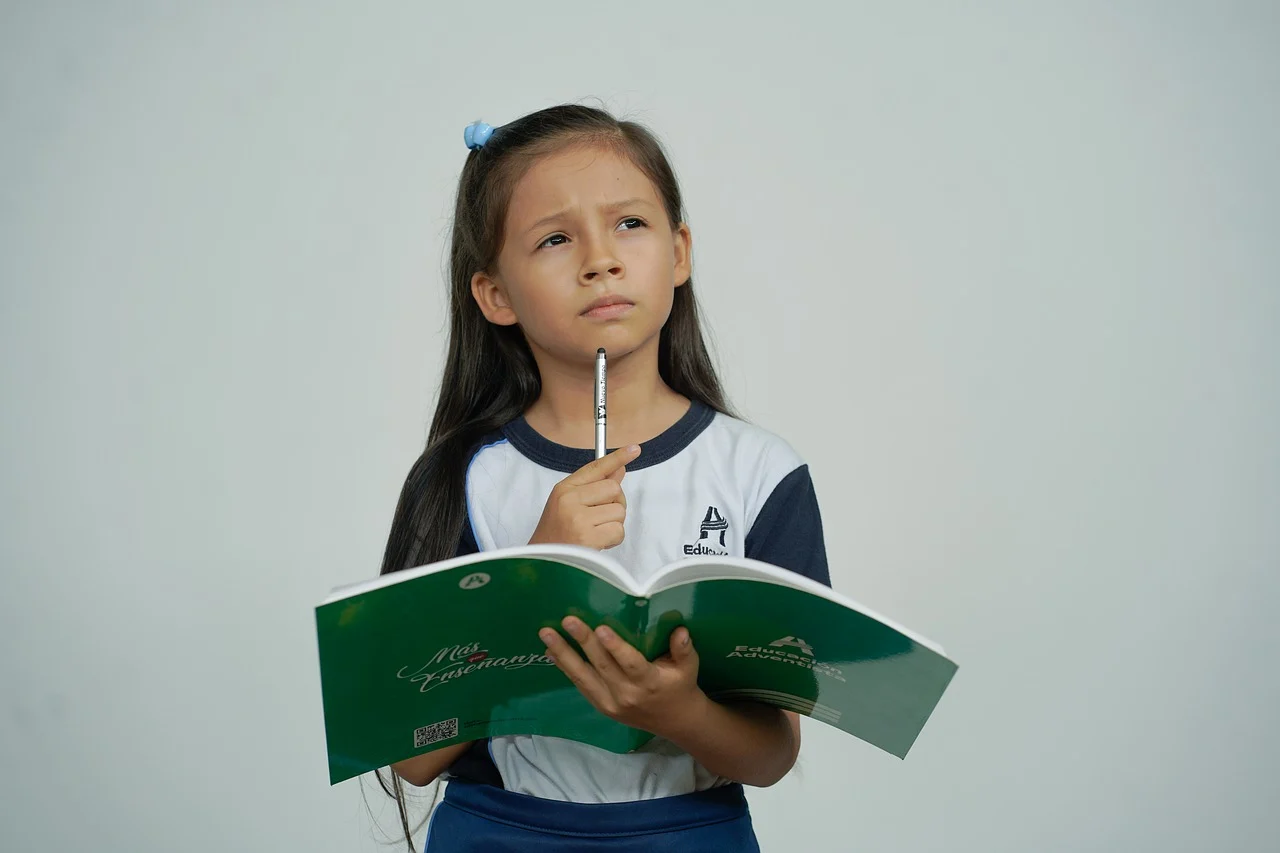
Non-routine problem solving is the core of what we do in our math olympiad programmes.
These problems do not have an obvious starting point. There is no single formula that acts as a skeleton key for every question.
Instead, your child must investigate the problem, look for hidden patterns, and try multiple strategies before they find a breakthrough.
An example of non-routine problem solving would be the following:
“In a stable, there are some people and some horses. If you count the heads, there are 10. If you count the legs, there are 28. How many horses are there in the stable?” There is no Legs-and-Heads Formula taught in standard textbooks. The student must investigate.
This approach forces a student to engage with the logic of the maths rather than just the mechanics. This is where real critical thinking is born. By removing the recipe for the answer, we allow your child to become a mathematical explorer.
Heuristics vs. Algorithms
Most primary school maths relies on algorithms. An algorithm is a step-by-step procedure that guarantees a result if followed correctly—think of long division or finding the area of a rectangle. Heuristics, however, are more like strategies. They are tools that help you explore a problem when you aren't sure which algorithm to use.
We teach your child how to use heuristics like "simplifying the problem," "logical reasoning," or "visualising the data." Instead of giving them a map, we give them a compass and a set of survival tools. This allows them to navigate unfamiliar territory. They learn that even if they don't know the answer immediately, they have the strategic tools to find it eventually.
Cognitive Load
Non-routine problems naturally increase a student's cognitive load. This refers to the amount of information and the number of logical steps a brain must hold at one time.
Math Olympiad tuition centres often present problems that require a higher level of mental stamina. Your child must track multiple variables and consider multiple constraints simultaneously.
This stretches the brain, much like an athlete stretches their muscles. Over time, this increased capacity allows them to handle the pressure of exams and real-world situations.
Creativity Involved
Logic and creativity are often seen as opposites, but in Math Olympiad training, they are inseparable.
To solve a non-routine problem, your child often needs to see the question from a completely new angle. This might involve drawing a diagram or imagining the problem in a different context.
For example, find the last digit of 7^2026.
A non-routine approach would be to look at the last digits of each of the powers of 7.
- 7^1 = 7 (Last digit is 7)
- 7^2 = 49 (Last digit is 9)
- 7^3 = 343 (Last digit is 3)
- 7^4 = 2401 (Last digit is 1)
- 7^5 = 16807 (Last digit is 7 again!)
- 7^6 = 117649 (Last digit is 9 again!)
- 7^7 = 823543 (Last digit is 3 again!)
- 7^8 = 5764801 (Last digit is 1 again!)
The last digits follow a cycle of four: 7, 9, 3, 1.
To find the last digit of 7^2026, we divide the exponent 2026 by the cycle length, 4.
2026 / 4 = 506, remainder 2.
The remainder 2 tells us the last digit is the same as the 2nd number in our cycle.
The answer is 9.
We encourage our students to be "brave" with their maths. This means trying out-of-the-box ideas even if they seem unconventional. When your child realises they can manipulate numbers and shapes creatively to find solutions, their interest in the subject grows. They stop seeing maths as a chore and start seeing it as a creative challenge to be conquered.
What are Math Olympiad Programmes?

These programmes are the training pathways that we offer to prepare students for the Math Olympiads.
Our programmes are designed to introduce students to topics and thinking methods that are not found in the standard classroom syllabus. Our goal is to build a toolkit of strategies that your child can use in any academic or competitive environment.
While the competitions are the goal, the true value lies in the months of training where your child's brain is being rewired for logic and efficiency.
How Do Math Olympiad Programmes Develop Critical Thinking in Primary Students?
We use a variety of mathematical domains to push your child's boundaries. Each of these topics is selected because it forces a student to use a different part of their logical brain. Here is a breakdown of the key concepts we cover and how they help your child grow.
Number Theory
Number theory is the study of the properties of integers. In these lessons, we look at how numbers interact, the secrets of prime numbers, and the logic of divisibility.
For example, find the smallest whole number that, when divided by 3, leaves a remainder of 1; when divided by 4, leaves a remainder of 2; and when divided by 5, leaves a remainder of 3.
To find the smallest whole number that satisfies these conditions, we look for a common factor.
- Divided by 3, remainder 1 (needs 2 more to reach the next multiple of 3)
- Divided by 4, remainder 2 (needs 2 more to reach the next multiple of 4)
- Divided by 5, remainder 3 (needs 2 more to reach the next multiple of 5)
We can see that in every case, the number is exactly 2 away from being a multiple of 3, 4, and 5. We find the Least Common Multiple (LCM) of 3, 4, and 5, which is 60. Since our mystery number is 2 short of this multiple: 60 - 2 = 58.
These types of problems test your child's ability to understand patterns and remainders. They have to move beyond simple division and learn how to synchronise different numerical cycles. It develops their ability to find commonality between seemingly unrelated numbers and builds a strong foundation for algebraic thinking later in life.
Combinatorics
Combinatorics is the branch of maths concerned with counting, arrangement, and permutation. It sounds simple—just counting things—but when the numbers get large, or the rules get complex, it requires intense logical organisation.
For example, how many different four-digit numbers can be formed using the digits 1, 2, 3, and 4, given that each digit can only be used once and the number must be even?
For a number to be even, it must end in an even digit. Using the set {1, 2, 3, 4}, the last digit must be either 2 or 4.
- If the last digit is 2: You have 3 choices for the first digit, 2 choices for the second, and 1 choice for the third. This gives 3*2*1 = 6 combinations.
- If the last digit is 4: You also have 3*2*1 = 6 combinations.
Adding these together, you get 12 possible numbers.
These problems develop your child's ability to categorise and organise information. They learn to set constraints (like the number being even) and then work within those boundaries. It is a fantastic way to improve their attention to detail.
Geometry and Visual Logic
In Math Olympiads, geometry is not just about measuring angles. It is about visualising shapes and understanding how they can be manipulated. We often use problems that require a student to use symmetry to find an answer.
For example, a large square is divided into four smaller, identical rectangles. If the perimeter of one small rectangle is 20cm, what is the area of the large square?
When you divide a large square into four identical rectangles, they are usually arranged as four long strips. If the side of the square is L, each rectangle has a length of L and a width of L/4.
Hence, the perimeter of one rectangle is 2 * (L + L/4) = 2.5L.
Since the perimeter of each rectangle is 20 cm:
20 = 2.5L
L = 8 cm.
The area of the large square is 8*8 = 64 cm².
Problems like these develop spatial awareness and visual logic. Your child learns to translate visual information into numerical data.
Heuristics
As we mentioned earlier, heuristics are the strategies used to solve problems.
For example, a group of 10 people meet at a party. If every person shakes hands with every other person exactly once, how many handshakes are there in total?
When 10 people shake hands, we use the formula for combinations where the order does not matter. The first person shakes hands with 9 others. The second person has already shaken hands with the first, so they shake hands with 8 others.
This continues as: 9 + 8 + 7 + 6 + 5 + 4 + 3 + 2 + 1 = 45.
This teaches the heuristic of "drawing a simpler version" of the problem. Your child might start with 2 people, then 3, then 4, looking for a pattern. It develops their ability to scale their thinking and apply small-scale logic to large-scale problems.
It also exercises their critical thinking—remembering that one cannot shake hands with oneself, or that two people shaking hands is a repeated instance that does not count. This is a vital skill for any future scientist or engineer.
Pigeonhole Principle
The Pigeonhole Principle is a fundamental concept in combinatorics. It states that if you have more items than containers, at least one container must hold more than one item. While it sounds basic, the applications are incredibly clever.
For example, if there are 13 people in a room, prove that at least two of them must have been born in the same month.
This is a classic application of the Pigeonhole Principle. There are only 12 months in a year. If you have 13 people, even if the first 12 were born in entirely different months, the 13th person must share a birth month with one of the others. Since 13 > 12, it is mathematically certain that at least two people share a month.
This develops the skill of logical certainty. Your child learns how to prove that something must be true, even if they don't know exactly who or where the result is. It teaches them to look for the worst-case scenario and understand the logical limits of a system.
Working Backwards
Many complex problems are easier to solve if you start at the end and work your way back to the beginning.
For example, a man spends half of his money on a shirt. He then spends half of the remaining money on a belt. Finally, he spends $10 on lunch and has $5 left. How much did he have at the start?
To find the answer, we start from the end and reverse every action.
- The man has $5 left.
- Before lunch, he had $15, since he had spent $10 on lunch.
- This $15 was what remained after he spent half on a belt. So, before the belt, he had $15 * 2 = $30.
- This $30 was what remained after he spent half on a shirt. So, at the very start, he had $30 * 2 = $60.
This develops the ability to reverse-engineer a process. Your child learns to identify the inverse of every action and apply it in the correct order.
Chicken and Rabbit
This is a classic problem type that we use to introduce the "Assumption Method." It involves two types of things with different attributes (like legs) and a total count of those attributes.
For example, a farmer has some chickens and some rabbits. Altogether, there are 20 heads and 52 legs. How many rabbits does he have?
We use the Assumption Method here. Assume all 20 animals are chickens.
20 heads * 2 legs = 40 legs.
However, the problem states there are 52 legs. The difference is 52 - 40 = 12 legs.
Each time we replace a chicken with a rabbit, we add 2 legs (4 - 2 = 2).
As such, the number of rabbits is 12 / 2 = 6.
This develops the skill of making a hypothesis and then adjusting it. We teach the child to assume all 20 animals are chickens. They then see that there are missing legs and learn to swap chickens for rabbits until the count is correct.
This is a foundational step toward understanding simultaneous equations and algebraic logic without the need for complex variables yet.
Excess and Shortage
Excess and shortage problems involve two different ways of distributing items, resulting in a surplus in one case and a deficit in the other. These are notoriously tricky for students who only rely on routine methods.
Let’s say a teacher wants to give her students some sweets. If she gives 5 sweets to each student, she has 10 left over. If she gives 7 sweets to each student, she is short of 4 sweets. How many students are there?
We look at the total change in the number of sweets and the change per student.
- Case A: 5 sweets per student, 10 left over (10 excess sweets)
- Case B: 7 sweets per student, 4 short (-4 excess sweets)
The difference in the number of excess sweets between the two scenarios is 10 - (-4) = 14.
The difference in the number of sweets given to each student is 7 - 5 = 2.
To find the number of students, we divide the difference in excess sweets (14) by the difference in sweets per student:
14 / 2 = 7 students.
So there are 7 students in the class. The teacher had 45 sweets.
Problems like these develop students’ abilities to compare two states and identify their differences. Your child learns to analyse change and understand how a small shift in one variable (sweets per student) leads to a large shift in the outcome. It builds logical deduction.
Build Your Child’s Critical Thinking with a Maths Tuition Centre Today!
We believe that every child has the potential to be a great thinker if they are given the right challenges. Our math olympiad programmes are not about rote learning or boring drills.
We want to spark a genuine interest in the logic of the world. By exposing your child to these non-routine problems, you are helping them build a resilient, sharp mind.
Your child's education should be an adventure in thinking.
At Terry Chew Academy, we are ready to guide them through that journey. We have the experience and the methods to help them succeed not just in competitions, but in their overall academic journey. You can give your child the edge they need by choosing a programme that prioritises true understanding over simple memorisation.
Book a free trial with us today and discover our pedagogy first-hand.
Frequently Asked Questions
Is this program only suitable for students who are already top scorers in their school math exams?
Not necessarily; while a baseline of numeracy is helpful, our focus is on developing a specific "growth mindset" and logical curiosity, which can benefit any student willing to embrace a challenge.
How does Math Olympiad training specifically assist with the PSLE mathematics paper?
Many of the trap questions found in Section C of the PSLE paper are essentially non-routine problems that require the same heuristics and logical deduction we teach in our Olympiad sessions.
Will my child be given homework, and how much time should they dedicate to it?
We prioritise quality over quantity, typically assigning a targeted set of problems each week that should take about 60 to 90 minutes to complete with focused effort. We have a No-Homework policy. We believe growing minds should have adequate rest.
Does Terry Chew Academy provide preparation for the Direct School Admission (DSA) process?
Yes, our training helps students build a strong portfolio of competition results and develop high-level problem-solving skills often tested during DSA selection trials and interviews.

 Like us