About the Author
Terry Chew, B.Sc. is a pioneering Singapore mathematics author and educator, and the first in Singapore to publish a Maths Olympiad workbook series, released in 2007. His titles, including Unleash the Maths Olympian in You! and Wicked Mathematics!, are widely used across Southeast Asia and internationally. He has coached students through Singapore’s major mathematics competitions for close to two decades.
Published Date
AI Summary
This guide helps parents choose their child's first mathematics competition in Singapore, comparing SASMO, SEAMO, RMO, NMOS, APMOPS, and SMO. The author recommends starting with SASMO (March–April) or SEAMO (August), as both are open from Primary 1 to Junior College with no qualifying score required, and their papers are designed to stretch without discouraging first-timers. As students gain confidence, they can progress to school-restricted contests like RMO, NMOS, APMOPS (primary), and SMO (secondary/JC). The article also explains that nearly all competitions are calculator-free and that formal training is optional for entry-level contests but recommended for advanced ones.
“Mr. Terry, which competition should my child try first?”
It is one of the questions parents ask me most often, usually when their child has just begun to show an interest in problem-solving beyond the school syllabus.
My answer is usually the same, and it lines up with what most informed parents already do.
Start with SASMO in March or SEAMO in August, then move up the ladder as your child's school level and contest experience grow.
SASMO and SEAMO are open from Kindergarten through Junior College, neither requires a qualifying score, and both are built to introduce a child to contest conditions without overwhelming them.
The goal isn't to chase the toughest competition as early as possible. It's to expose your child to age-appropriate contests that gradually build confidence, competition experience, and mathematical thinking. As they mature and gain exposure, they naturally become ready for more demanding challenges.
Key Takeaways
- SASMO and SEAMO are the most beginner-friendly competitions in Singapore, open from Kindergarten through Junior College with no qualifying score required.
- School level determines eligibility for RMO, NMOS, APMOPS, and SMO, which are better suited to students with prior competition experience.
- Confidence with timed, calculator-free problem solving matters more at the beginning than raw ability.
- Most first-time competitors begin in Primary 3 to 5 or Secondary 1 to 2, then progress to tougher contests as they gain exposure.
What Are the Major Mathematics Competitions in Singapore, and When Are They Held?
The six major mathematics competitions in Singapore are SASMO, SEAMO, RMO, NMOS, APMOPS, and SMO.
- SASMO (late March to early April) and SEAMO (late August) are open across all levels, from Primary 1 to Junior College. These are the two I usually recommend for first-timers.
- RMO, NMOS, and APMOPS run between March and July, and are intended for more experienced primary school students.
- SMO, held in early June, is the flagship contest for Secondary and Junior College students.
Each competition has its own character, and the right one for your child depends less on prestige than on fit.
If you're weighing up which one to enter first, here’s how to prepare for maths competitions in Singapore, including how far in advance to start and what each format actually tests.
What to Consider Before Choosing a First Competition
Over the years, I have found that four factors matter more than any other when helping a parent decide.
- Age and school level. Some competitions, such as SASMO and SEAMO, are open across all levels. Others, such as RMO and APMOPS, restrict entry by primary year, which narrows the choice considerably.
- Confidence with timed, calculator-free problem solving. Nearly every competition in Singapore is set without a calculator. If your child has not yet worked under those conditions, it is worth beginning with a gentler paper.
- Difficulty level. Competitions vary in how far they stretch beyond the school syllabus. A first competition should stretch a child, not discourage them.
- Contest timing. Competitions are spread across the calendar. Knowing when registration opens and when the paper falls is essential when planning preparation around school terms and examinations.
Best First Competitions for Beginners
SASMO (Singapore and Asian Schools Math Olympiad)
When a parent asks me where to begin, my first suggestion is almost always the Singapore and Asian Schools Math Olympiad (SASMO).
It now draws participants from over 50 countries and territories, with more than 700,000 students having taken part to date.
What makes it a strong first competition is that it sits deliberately between the school syllabus and full Olympiad-style problems, challenging enough to be meaningful, gentle enough not to unsettle a young learner.
The paper is split into two sections: 15 multiple-choice questions in Section A (with negative marking for wrong answers) and 10 open-ended questions in Section B (no negative marking).
It means a child can attempt the earlier questions freely, without every wrong answer being penalised. Awards are tiered, with roughly:
- the top 8% receiving Gold
- the top 20% Silver
- the top 40% Bronze.
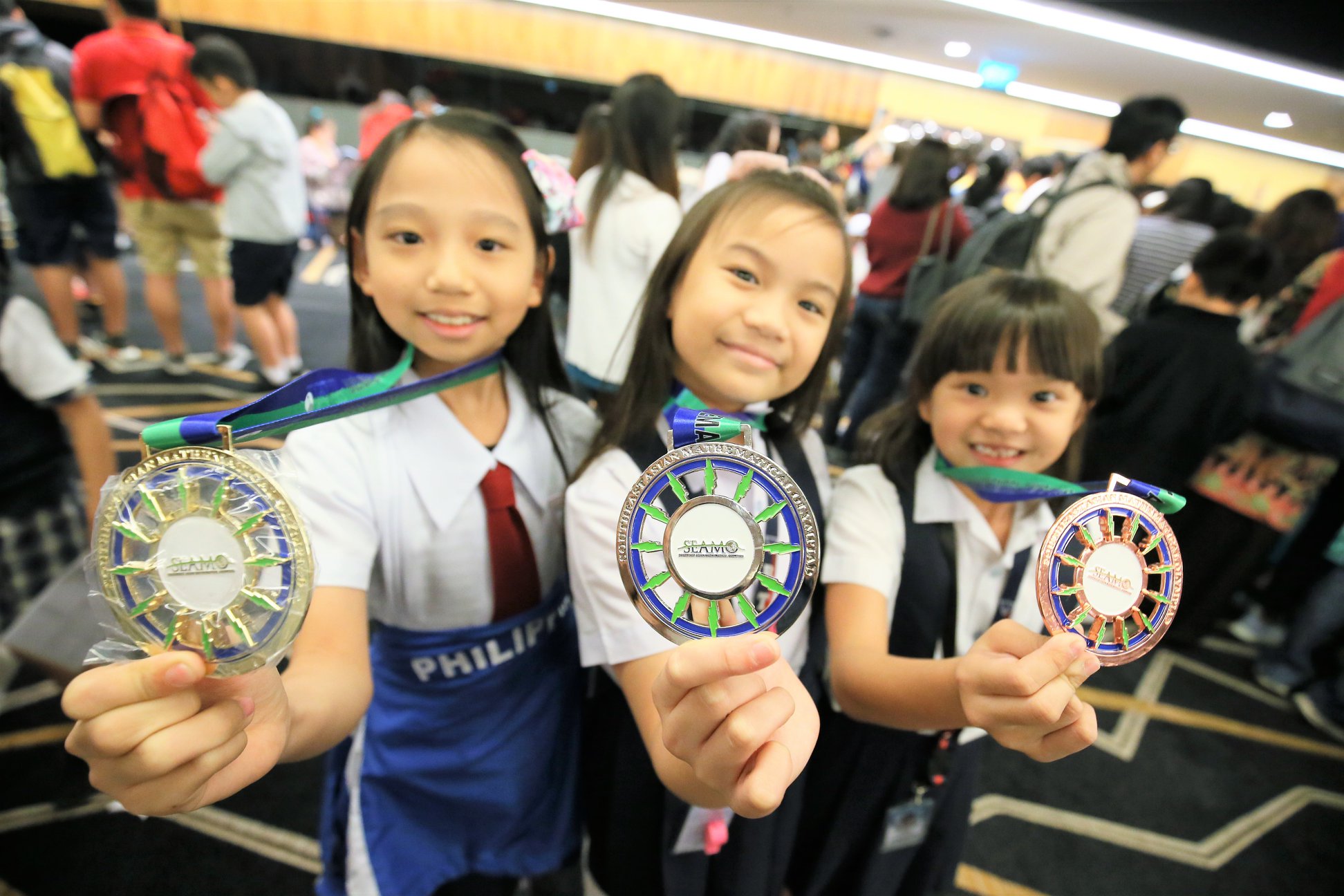
The Top 40% overall receive award certificates and medals; others receive e-Certificates.
SASMO is held in late March to early April, and top scorers are invited to the Singapore International Mathematical Olympiad Challenge (SIMOC) in July.
SEAMO (Southeast Asian Mathematical Olympiad)
SEAMO works well as a second competition later in the year, or as a first competition if your child missed the SASMO window. Like SASMO, it is open to students from Primary 1 to Junior College and runs in more than 20 countries.
It's a good entry point: familiar enough to feel accessible, unfamiliar enough to be worthwhile. Papers run for 90 minutes and include 25 multiple-choice questions at the primary levels.
The local round is held in late August, with top performers invited to the SEAMO X global finals the following January.
Competitions to Consider Once Your Child Has More Confidence
RMO (Raffles Mathematical Olympiad, formerly RIPMWC)
The Raffles Mathematical Olympiad (RMO), organised by Raffles Institution, was for many years known as the Raffles Institution Primary Mathematics World Contest (RIPMWC). The name has changed, but its standing among primary-level contests has not.
RMO runs in two rounds. Round 1 is an online paper set at the child’s own school, and top performers are invited to a written Round 2 held at Raffles Institution itself. There are separate Junior (Primary 4 and 5) and Open (Primary 6) categories, usually held in March.
Registration is typically handled through the child's school. Parents whose children are at schools that do not participate can contact Raffles Institution directly for guidance.
NMOS (National Mathematical Olympiad of Singapore)
The National Mathematical Olympiad of Singapore (NMOS) is co-organised by NUS High School of Mathematics and Science and the Singapore Mathematical Society. It is open only to Primary 5 students and consists of two rounds: a Heat Round taken at the child's school, and a Special Round for top scorers.
NMOS is held in July, and it is a contest I generally suggest only after a child has one competition behind them. It has long been part of the pipeline through which NUS High identifies mathematically inclined students, and the calibre of the questions reflects that.
APMOPS (Asia-Pacific Mathematical Olympiad for Primary Schools)
Organised by Hwa Chong Institution, the Asia-Pacific Mathematical Olympiad for Primary Schools (APMOPS) is, in my view, the most demanding of the primary-level contests. It is often taken by Primary 6 students building a Direct School Admission (DSA) portfolio.
APMOPS runs in two rounds. Round 1 is held online in early April, and the questions draw heavily on Olympiad heuristics, particularly the pigeonhole principle, number theory, and combinatorics. Top scorers from Singapore progressed to the Invitation Round, held on 30 May 2026 at Hwa Chong Institution.
SMO (Singapore Mathematical Olympiad)
The Singapore Mathematical Olympiad (SMO) is Singapore’s flagship secondary-level competition. Organised by the Singapore Mathematical Society, it has run since 1988 and is divided into three sections: Junior (Secondary 1 and 2), Senior (Secondary 3 and 4), and Open (Junior College). The contest is held in early June.
Round 1 rewards speed and accuracy across a mix of multiple-choice and short-answer questions. Round 2, reserved for top scorers, requires full written proofs, a significantly different skill, and one that separates SMO from every primary-level contest in Singapore. Top SMO performers form the training pool from which Singapore’s International Mathematical Olympiad (IMO) team is selected.
Major Mathematics Competitions in Singapore at a Glance
| Competition | Levels | Typical Timing | Organiser | Best Suited For |
| SASMO | Primary 1 to Junior College | March–April | SIMCC | First-time competitors |
| SEAMO | Kindergarten to Junior College | August | SEAMO Committee | Second competition or year-end milestone |
RMO
| Primary 4-5 (Junior), Primary 6 (Open) | March | Raffles Institution | Stronger primary students are ready for a written round |
| NMOS | Primary 5 | July | NUS High & SMS | Students with prior competition experience |
| APMOPS | Primary 6 | April | Hwa Chong Institution | Top primary students, often DSA-focused |
| SMO | Secondary 1 to Junior College | June | Singapore Mathematical Society | Secondary and JC students ready for proof-based rounds |
How to Match a Competition to Your Child’s Profile

- If your child has never sat a competition: Begin with SASMO or SEAMO, regardless of school level.
- If they have one competition behind them and performed well: Continue with the same competition, and consider NMOS or RMO as a reasonable next step for Primary 5 and 6 students.
- If they are a Primary 6 student preparing a DSA portfolio: APMOPS is often the natural goal once earlier rounds have gone well.
- If they are a Secondary or Junior College student, comfortable with school mathematics: SMO is the contest to work towards.
For a fuller picture of what preparation looks like once you have chosen a competition, I have written a companion piece on how to prepare for maths competitions in Singapore.
Choosing the Right First Step
After nearly two decades of coaching students through these contests, I can confirm that most children benefit from starting with a friendlier, school-level competition before working up to tougher ones.
The right first step depends on your child's grade level, their comfort with timed problem-solving, and how much exposure they have had to problems that do not come with an obvious method attached.
For most children, that starting point stretches them just enough, gives them a positive first experience, and gives you, as a parent, a fair sense of where they stand before the ladder gets steeper.
If you would like a clearer understanding of where your child currently stands before committing to a competition, I would be glad to have them attend a trial lesson at my centre. I would rather observe how a child thinks and works through problems during a lesson than judge them based on a form.
Book a free trial with us, and the team will help you take the next step.
Frequently Asked Questions
What is the most popular maths competition for a starter in Singapore?
Most students beginning their maths olympiad journey in Singapore start with SEAMO or SASMO. It has no qualifying score, runs from Kindergarten through Junior College, and its paper design lets students attempt earlier questions without a single wrong answer derailing the whole paper. This makes it a common first step before students move on to RMO, APMOPS, and other selective competitions as they progress
Can secondary school students join the same competitions as primary school students?
Yes. SASMO and SEAMO both span Primary 1 to Junior College. Secondary students sit their own paper at their own level, alongside younger participants but not competing directly against them.
Does my child need training before their first competition?
For SASMO or SEAMO, formal training is not required. Many children take these papers with only a few practice sets at home. Some exposure to timed, calculator-free practice helps settle nerves on the day. For RMO, NMOS, APMOPS, or SMO, structured preparation is recommended.
How is Math Olympiad enrichment different from school mathematics?
Olympiad enrichment goes beyond arithmetic and standard word problems. The focus is on problems that stretch beyond the standard syllabus, develop higher-order thinking, reasoning, and the ability to approach a question without a ready-made method attached.
Are Singapore maths competitions taken with a calculator?
No. All six major Singapore mathematics competitions (SASMO, SEAMO, RMO, NMOS, APMOPS, and SMO) are set without a calculator.

 Like us