You want your child to excel in Singapore maths competitions, but Olympiad training can be overwhelming. After all, there’s the competitive environment to prepare for, as well as the mathematical concepts to master and remember.
So, how should your child go about preparing for the maths competitions?
Our guide outlines exactly what you need to know about the local competition circuit and how we recommend you approach your preparation.
Key Takeaways
- Singapore’s major math competitions, such as SMO, SASMO, RMO, NMOS, SEAMO, and APMOPS, serve as critical benchmarks for analytical skills and are pivotal for DSA applications.
- Successful preparation requires a super-curricular approach that extends standard MOE concepts into the realm of complex Olympiad logic.
- Mastery of mathematical heuristics, such as working backwards and pattern recognition, is essential for solving problems where standard algebraic methods might not apply.
- Consistent practice with past-year papers and mock exams builds the mental endurance needed for long, calculator-free competition rounds.
- Beyond technical knowledge, a student’s competition success depends on their ability to manage the risks of negative marking and keep time-bound pressure at bay.
What Are the Maths Competitions to Prepare For in Singapore
These events are not just about winning medals; they serve as a benchmark for your child's analytical skills and persistence. The following are some of the maths competitions children participate in in Singapore.
Singapore Mathematical Olympiad
The Singapore Mathematical Olympiad (SMO) is perhaps the most well-known event on the calendar.
Organised by the Singapore Mathematical Society, it attracts the brightest minds from secondary schools and junior colleges across the island.
The competition is divided into sections based on age and academic level. The Junior and Senior sections are typically held in early June, with the 2026 dates expected around June 3rd.
- The Junior section is for students in Secondary 1 and 2.
- The Senior section targets Secondary 3 and 4.
- If your child is in Junior College, they will enter the Open Section, which usually takes place the following day, on June 4th.
The SMO format is divided into two distinct rounds.
Round 1 is a written paper where students must provide short answers to a variety of problems. It tests speed and accuracy across topics like geometry, number theory, and algebra. If your child performs in the top tier during this first round, they are invited to Round 2.
This second stage is significantly more demanding as it involves long-form proofs. Here, the examiners are not just looking for the right answer; they want to see the logical progression of the argument. Your child must be able to articulate their mathematical reasoning on paper, a skill we focus heavily on in our classes.
Singapore and Asian Schools Math Olympiad
The Singapore and Asian Schools Math Olympiad (SASMO) is one of the largest contests in Asia.
We often recommend this as a starting point for students who are new to the world of competitive math. It acts as a necessary link between the standard school syllabus and the high-level Olympiad problems found in the SMO.
SASMO is usually held in April, with the 2026 date likely falling around the end of March and start of April.
One of its greatest strengths is its inclusivity, as it caters to a wide range of ages from Primary 1 to Junior College. This allows your child to build a competitive portfolio from a very young age.
The significance of SASMO extends beyond the local certificate. High scorers often receive invitations to the Singapore International Math Olympiad Challenge (SIMOC), which takes place in July.
Asia-Pacific Mathematical Olympiad for Primary Schools
If your child is in primary school, the Asia-Pacific Mathematical Olympiad for Primary Schools (APMOPS) is the gold standard.
Organised by Hwa Chong Institution, this competition is a major milestone for Primary 6 students looking to secure spots in top secondary schools through Direct School Admission (DSA).
The first round of APMOPS is held in April.
It is a rigorous test of problem-solving speed and the ability to apply heuristics to questions. Participation in APMOPS is a prestigious achievement. It pits your child against the best primary school mathematicians from across the Asia-Pacific region.
To succeed here, your child needs to have a firm grasp of complex concepts such as the pigeonhole principle, combinatorics, and advanced area problems.
Southeast Asian Mathematical Olympiad (SEAMO)
SEAMO is a prestigious international platform designed to "unleash the maths Olympian" in every child.
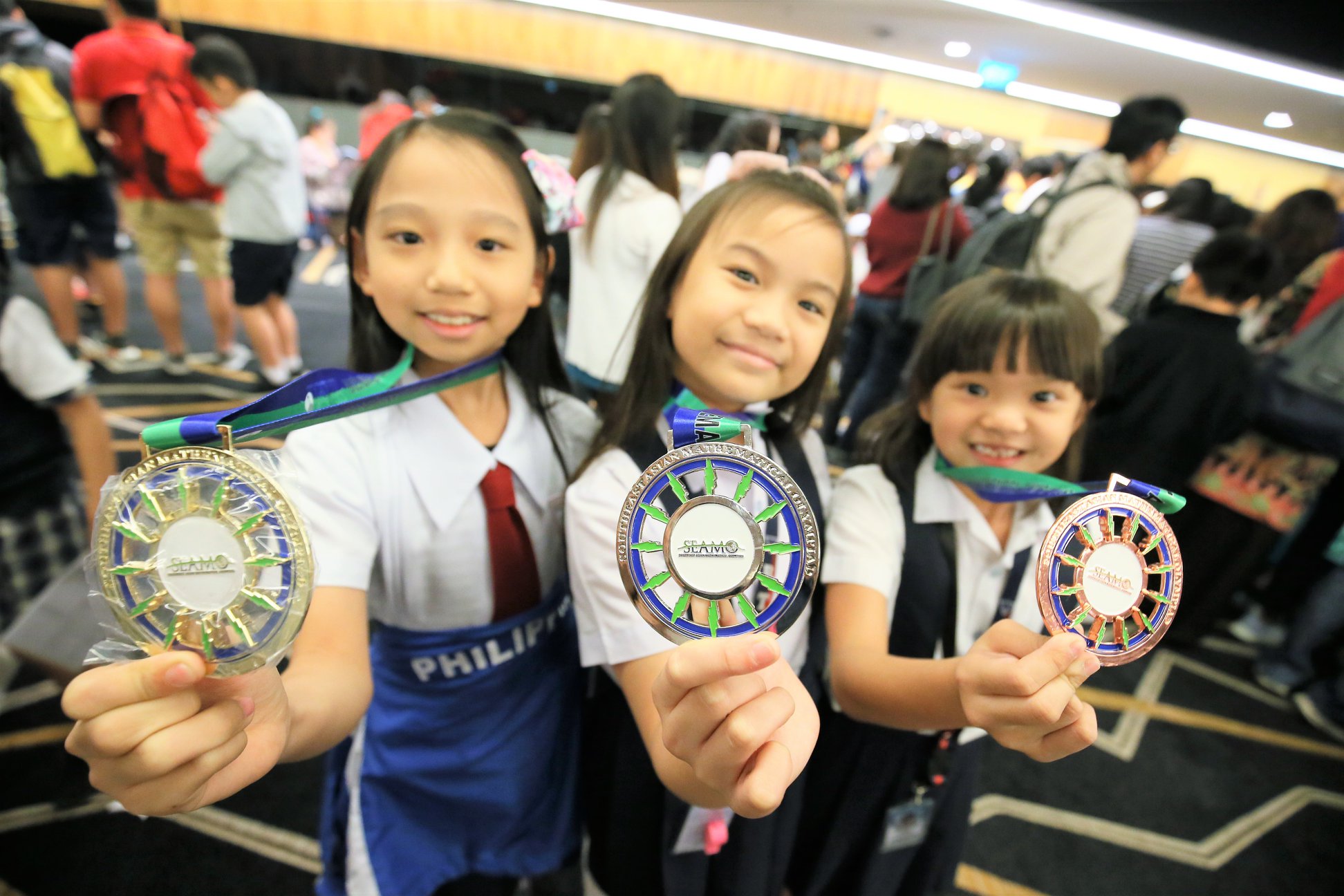
Founded by Mr Terry Chew, a renowned name in Mathematical Olympiad training, this competition has grown into a massive global movement with over 20,000 participants across 18 regions.
What sets SEAMO apart is its focus on out-of-the-box thinking. The syllabus is designed so that only about 40% of the content overlaps with the standard school curriculum, while the remaining 60% is modified to meet international Olympiad standards.
The local round is typically held in late September, making it an excellent year-end milestone to measure how much your child has progressed throughout their training.
Much like SASMO, SEAMO is highly inclusive. It offers a range of papers tailored to levels from Primary 1 to Junior College (Year 12).
Top performers (the top 40% of participants) are invited to compete in SEAMO X, the global grand finals held in January the following year. This international arena lets your child compete against mathematicians from countries such as Australia, India, and South Korea.
How to Prepare for Maths Competitions in Singapore
You cannot cram for an Olympiad the week before the exam. At our academy, we advocate for a consistent, sustainable approach that builds your child's confidence alongside their technical skills.
The following are ways you can prepare for various maths competitions, and even tests within your child’s school.
Have a Super-curricular Approach to the Syllabus
While the MOE syllabus provides a foundation, it needs to be supplemented if a child is to prepare for a Singapore maths competition.
Our method involves taking the core topics taught in school and extending them into the realm of Olympiad logic.
For example, while school math might teach your child how to calculate the area of a circle, a tuition centre’s super-curricular approach will teach them how to apply that knowledge to solve complex shaded-area problems involving multiple overlapping shapes.
We look at the underlying principles of mathematics rather than just memorising formulas. This ensures that when your child sees a question they have never encountered before, they have the tools to deconstruct it and find a solution.
Use Past Year Series
There is no substitute for practising with actual contest papers.
Using past-year papers from SMO, SASMO, SEAMO, and APMOPS helps your child familiarise themselves with the nature of the questions asked by different organising bodies.
When your child works through these papers, they begin to notice patterns. They see how certain topics are prioritised and how the difficulty level ramps up towards the end of the paper.
We encourage our students to use these papers not just for practice, but for timing. Solving a difficult problem is one thing; solving it in under two minutes under exam conditions is another. Regular exposure to past papers eliminates potential surprises on the actual competition day.
Join Specialised Training Programs
Self-study can only take your child so far.
Joining a specialised training program provides the mentorship and peer environment necessary for growth.
In our classes, we foster a culture of inquiry where students are encouraged to dissect commonly accepted mathematical concepts.
Tuition centres rarely overwhelm a student with information. Instead, they provide incremental challenges that keep them engaged. Tutors are experts at maintaining students' attention by digesting complex information into understandable formats.
Furthermore, being in a room with other motivated students pushes your child to work harder. This is often the case with tuition centres. Through this collaboration, they see different ways of approaching the same problem, which broadens their mathematical perspective.
Focus on Mathematical Heuristics and Problem-Solving Strategies
Heuristics are the shortcuts and strategies that make difficult problems manageable.
In Singapore maths competitions, you will often find questions that seem impossible to solve using standard algebraic methods.
This is where heuristics like "Working Backwards" or "Finding a Pattern" come into play.
If a problem involves a series of operations with a known end result, working backwards is usually the most efficient route.
If the problem involves complex relationships between numbers, a visual model can provide students with a eureka clarity. Mastery of these strategies transforms a daunting task into a highly stimulating venture.
Build Mathematical Endurance through Mock Exams
Many students fail not because they lack the knowledge, but because they lack the stamina.
A typical Olympiad paper can last two hours or more, requiring intense concentration. This level of mental exertion is not one most school-bound students might be used to.
Tuition centres might hold mock exams to build this endurance. These sessions replicate the exact conditions of the competition, from the seating arrangements to the time limits.
By the time your child sits for the actual SASMO or SMO, they are mentally toughened.
Leverage Online Platforms and Global Competition Archives
The world of mathematics is vast, and you should not limit your child's resources to just Singapore-based materials. We encourage the use of global competition archives, such as those from the American Mathematics Competitions (AMC) or the Australian Mathematics Competition. Even a trip through YouTube can yield significant results.
Online platforms offer a wealth of diverse problem sets that challenge your child in different ways. Exposing your child to these different styles ensures they are well-rounded and adaptable. It also keeps the learning process fresh and exciting, as they can see how math is tested in different cultures and educational systems.
Develop Mental Calculation and Estimation Skills
In many Singapore maths competitions, calculators are strictly prohibited. This means your child's mental calculation skills must be reliable.
Tuition centres usually integrate mental calculation drills into their training. Perhaps these centres teach proprietary shortcuts or systems that students can use. These shortcuts often result in faster calculations and reduced mental effort.
Mental calculation techniques might involve rapid multiplication, division, and the use of number properties to simplify calculations.
Be Well Rested
It sounds simple, but rest is a critical component of competition prep. A tired brain cannot perform the high-level cognitive functions required for Olympiad math.
Students might be compelled to study late into the night before a big contest. This is usually counterproductive.
Your child needs adequate sleep to ensure their memory and logical reasoning are sharp. On the day of the competition, your child should arrive feeling fresh and alert, ready to tackle the challenges ahead.
What to Expect During a Maths Competition in Singapore
Here’s what you and your child should expect during any math competition in Singapore:
Rigorous Conduct and Standardisation
The atmosphere of a Singapore maths competition is quite formal. Your child will be required to bring their identification, and invigilators will ensure that no unauthorised materials are brought into the room.
Students are expected to remain silent and focused on their own work throughout the test. We advise our students to arrive at least thirty minutes early to find their assigned seats and settle their nerves.
Understanding that this is a formal event helps your child take the process seriously and get acclimated to competitive testing environments going forward.
Zero Calculator Policy
As mentioned earlier, the vast majority of these competitions do not allow calculators. This applies to all primary school contests and most secondary school rounds.
Your child will be provided with paper for their mathematical workings, but all the heavy lifting of the arithmetic happens in their head.
If your child has become overly reliant on a calculator for school work, this will be one of the biggest hurdles they face. Part of our training involves detoxing from the calculator and rebuilding that core numerical fluency.
Two-Stage Pressure (Round 1 vs. Round 2)
If your child is competing in the SMO or APMOPS, they must prepare for a mental shift between rounds.
Round 1 is often a test of breadth—covering many topics with relatively straightforward (though still difficult) questions. The pressure here often centres on time management.
Round 2 is a test of depth. The questions are fewer, but they require a much higher level of mathematical maturity. Your child might spend an hour on a single proof.
This stage is where many students feel the most pressure, as there is no easy way to gain marks. Every point must be earned through rigorous logic and calculation.
We prepare our students for this by teaching them the formal language of mathematical proofs, ensuring they know how to state their assumptions and conclude their arguments correctly. We also help them develop their mental stamina, preparing them for rigorous questions.
Negative Marking
In some contests, an incorrect answer might actually result in a deduction of marks, whereas leaving the question blank results in zero marks.
This discourages guessing. Your child cannot simply guess when unsure, which is a departure from the test system they have developed for school quizzes and exams.
They must make a calculated decision: is their confidence in their answer high enough to risk a deduction?
We teach our students how to evaluate their own certainty. We provide them with strategies to eliminate obviously wrong options in multiple-choice questions, enabling them to take calculated risks.
Get In Touch with a Math Tuition Centre Today
If you want to give your child the best possible chance of success in Singapore maths competitions, look beyond the classroom. The skills required for Olympiad math—logical reasoning, persistence, and the application of heuristics—are the same skills that will serve them well in their future academic and professional lives.
We invite you to visit us at Terry Chew Academy to learn more about our specialised programs. We offer a range of classes tailored to different age groups and skill levels, all focused on our super-curricular methodology. Our goal is not just to help your child win a medal, but to foster a lifelong love for mathematics and a confidence in their own problem-solving abilities.
You can reach out to us for a free trial class and see our approach for yourself.
Frequently Asked Questions
If my child misses the registration deadline for a school-hosted competition, can they register privately?
While some competitions, like SASMO, allow private candidates through authorised centres, others, like the SMO, typically require registration through the student's school. It is best to check with the specific organising body for that year’s private entry rules.
What is the difference between a "Gold" award and a "Platinum" award in competitions like APMOPS?
Awards are usually percentile-based; for instance, "Platinum" typically represents the top 1.5% of participants, while "Gold" covers the next tier, roughly the top 1.6% to 4%.
How do these competitions impact my child’s school GPA or internal grades?
Participation in external Olympiads does not directly affect a student’s school GPA, but the advanced problem-solving skills gained often lead to significantly higher scores in standard school assessments.
Is there a dress code for attending these competitions at external venues?
Students are generally expected to wear their official school uniform when attending competitions hosted by tertiary institutions or other schools.
If my child qualifies for an invitation round (Round 2), is there an additional fee?
For most major competitions like APMOPS or SMO, the initial registration fee covers the invitation round if the student qualifies, though some international-level rounds may require a separate administrative fee.

 Like us